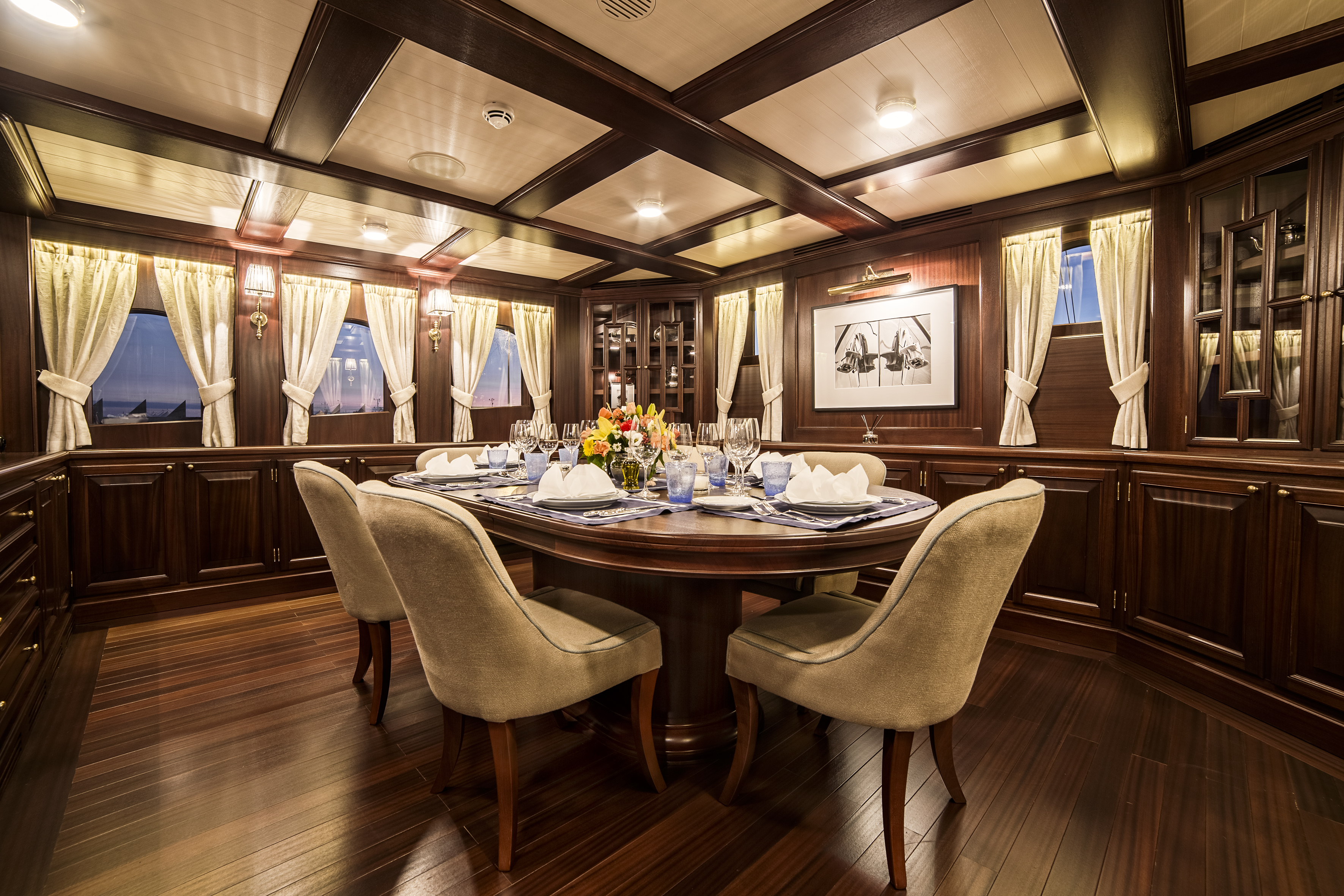
ClaR85 / Wikimedia Commons — Taransay Dining room, CC BY-SA 4.0. Illustrative photograph, not evidence of this yacht's acoustic performance; displayed with layout cropping. Licence and original linked below.
Luxury has a sound signature
A yacht may be visually extraordinary yet feel tiring after several hours underway. The difference is often not the quality of the marble or the size of the windows, but what passengers hear and feel: a low-frequency hum through the deck, a faint propeller beat in the aft cabin, a generator cycling during dinner or a ventilation outlet that never quite disappears into the background. Acoustic comfort is an engineering outcome, not merely an interior-design finish. Designers must consider the sources of noise, the paths by which energy travels through the vessel, and the spaces in which people expect to rest. The best result is not absolute silence, which is rarely realistic at sea, but a controlled, consistent acoustic environment.
Three problems that should not be confused
Airborne noise travels through air from equipment, voices, fans and machinery enclosures. Structure-borne vibration moves through mounts, foundations, bulkheads and decks before becoming audible or perceptible elsewhere. Hydrodynamic noise originates around the hull and propulsors, especially when operating conditions create turbulent flow or cavitation. Each requires different remedies. Thick soft furnishings may make a room sound less reflective without solving a low-frequency vibration transmitted through its floor. A quieter engine enclosure may reduce airborne sound while leaving shaft or generator vibration largely unchanged. This is why competent acoustic design starts with diagnosis and measurement rather than a catalogue of attractive insulating materials.
The machinery foundation matters as much as the machinery
Engines, generators, pumps, compressors and air-conditioning equipment create forces that can enter the hull structure. Resilient mounts, appropriate foundations and flexible connections can interrupt some of those transmission paths, provided they are selected for the actual machinery mass, operating speeds and loads. Poorly designed isolation can introduce new resonances or compromise alignment, so the solution is not simply to add softer mounts. On an existing yacht, a persistent vibration may come from machinery alignment, damaged mounts, a pipe touching a bulkhead or a structural element that bypasses an isolation system. Tracing the path is often more effective than adding decorative acoustic panels in the affected cabin.
Propellers can change the character of the whole aft deck
A propeller is designed to convert shaft power into thrust, but the surrounding water does not behave identically at every speed or load. Blade geometry, wake distribution, clearance and cavitation behaviour influence noise and vibration. Cavitation can produce an unmistakable broadband sound as vapour cavities form and collapse. It is not enough to specify a quiet engine if the propeller-hull interaction becomes the dominant source at cruising speed. Naval architects therefore need to consider the hull, appendages, propulsion train and operating profile together. Improvements in one area can shift the acoustic problem elsewhere. A meaningful comfort assessment should distinguish slow manoeuvring, normal passage speed and the conditions owners actually use.
Cabin location is a design decision
On many yachts, the distance between a cabin and the engine room, generators, stabiliser equipment or propeller region has an obvious influence on acoustic exposure. Yet physical separation is only part of the answer. Structure-borne energy can travel along continuous members, while ducts and service penetrations can undermine otherwise effective partitions. Owners should pay attention to where guest suites, crew cabins and quiet lounges sit in relation to major equipment. A glamorous layout drawing rarely shows these invisible relationships. During design review, ask the naval architect and acoustic consultant to explain the predicted sources for each accommodation zone and the mitigation planned before interior joinery is finalised.
The hidden work behind a quiet interior
Floating floors, resiliently supported linings, acoustic doors, careful sealing and properly detailed bulkheads can improve comfort when used as parts of a coherent system. Their effectiveness depends on installation details: a rigid screw, unsealed penetration or incorrectly supported duct may create an unintended sound bridge. Luxury finishes introduce additional constraints. Stone and glass have visual appeal but can be reflective; heavy materials may also affect weight distribution and structural design. A good interior team coordinates acoustics, fire safety, maintenance access and weight from the start. Retrofitting after delivery is possible, but it may involve opening expensive finished surfaces and can become disproportionately disruptive.
Ventilation is the overlooked guest experience
Even when propulsion machinery is quiet, ventilation may be the dominant sound in a cabin at anchor. Fan selection, duct velocities, bends, silencers and diffuser placement all affect the result. A system can provide adequate cooling while creating an annoying hiss or low rumble. Conversely, reducing airflow indiscriminately to make a room quieter can harm comfort and air quality. The design objective is a stable climate delivered with controlled acoustic performance. Owners should evaluate the yacht in several modes: generators running, shore power connected where available, air-conditioning at a typical setting and overnight operation. The difference between a serene guest suite and a restless one may only become obvious after the lights go out.
What the standards actually tell you
The International Maritime Organization adopted its Code on Noise Levels on Board Ships in resolution MSC.337(91). Its applicability depends on vessel type, size, build dates and regulatory context; it should not be assumed that every private yacht is subject to the same mandatory limits. More importantly, occupational noise limits and premium guest comfort are not identical goals. Classification societies offer additional voluntary assessments. DNV describes a Comfort Class with COMF-V for noise and vibration, separate from its VIBR and SILENT notations. Bureau Veritas also offers yacht comfort assessments addressing sources such as engines and propellers. A notation can provide structured evidence, but buyers must check its exact scope and the conditions under which measurements were taken.
Why measurement conditions change the result
A decibel figure is not meaningful without a location, operating state and measurement method. Was the yacht at anchor, alongside, cruising at a normal speed or operating near maximum power? Were generators and air-conditioning running? What were the sea conditions, machinery loads and background noise? A-weighted sound levels are useful, but a single average can miss tonal annoyance, intermittent events and perceptible low-frequency vibration. The IMO code sets out measurement procedures for applicable ships, including considerations around operating and environmental conditions. Owners commissioning a yacht should request a clear test matrix and documented results by room, rather than a single headline number that sounds impressive in a brochure.
The crew experience cannot be separated from guest luxury
Guest areas may be designed for quiet evenings, while crew accommodation is often closer to working machinery and service routes. That does not make noise and vibration irrelevant below deck. Crew members may spend long periods aboard, and disrupted rest can affect wellbeing and performance. A serious comfort brief should therefore include cabins, mess spaces and working areas used by crew, not only the owner's suite. The commercial and regulatory context varies, but the design principle is straightforward: comfort should be assessed across the vessel. A yacht that appears silent in the main saloon while transmitting persistent vibration into crew quarters has not solved the whole problem.
Underwater noise is a related but distinct issue
Noise radiated into the sea can affect marine life, particularly species that rely on sound. It is connected to machinery and propeller design, but a quiet guest cabin does not automatically prove low underwater emissions, nor does a low underwater signature guarantee a comfortable interior. Bureau Veritas describes an Underwater Radiated Noise notation based on acoustic measurements, with attention to engines, propellers and cavitation. DNV likewise distinguishes its SILENT notation from onboard Comfort Class. Owners who care about both guest experience and environmental impact should specify both objectives explicitly. This is an area where clear performance requirements matter more than broad claims that a yacht is 'eco-friendly' or 'silent'.
How an owner should specify quiet
Before a newbuild contract is finalised, identify the spaces that matter most, the operating conditions in which they will be used and the independent evidence expected at delivery. Ask who is responsible for acoustic modelling, how machinery suppliers coordinate with the yard, whether target levels are contractual and how defects will be remedied if trials reveal problems. For a brokerage yacht, request existing noise and vibration reports if available and listen carefully during a properly planned sea trial. Take note of where vibration is felt, not only where sound is heard. Quiet luxury is difficult to photograph, but it is measurable, designable and—when handled early—one of the most convincing forms of quality at sea.
Sources & further reading
International Maritime Organization — Resolution MSC.337(91), Code on Noise Levels on Board Ships ↗
DNV — Class Notations: Noise and Vibration ↗
Bureau Veritas — Yachts and Onboard Comfort ↗
Bureau Veritas — Underwater Radiated Noise ↗
Lead photograph: ClaR85 — Taransay Dining room (Wikimedia Commons) ↗
Photograph licence: Creative Commons Attribution-ShareAlike 4.0 ↗