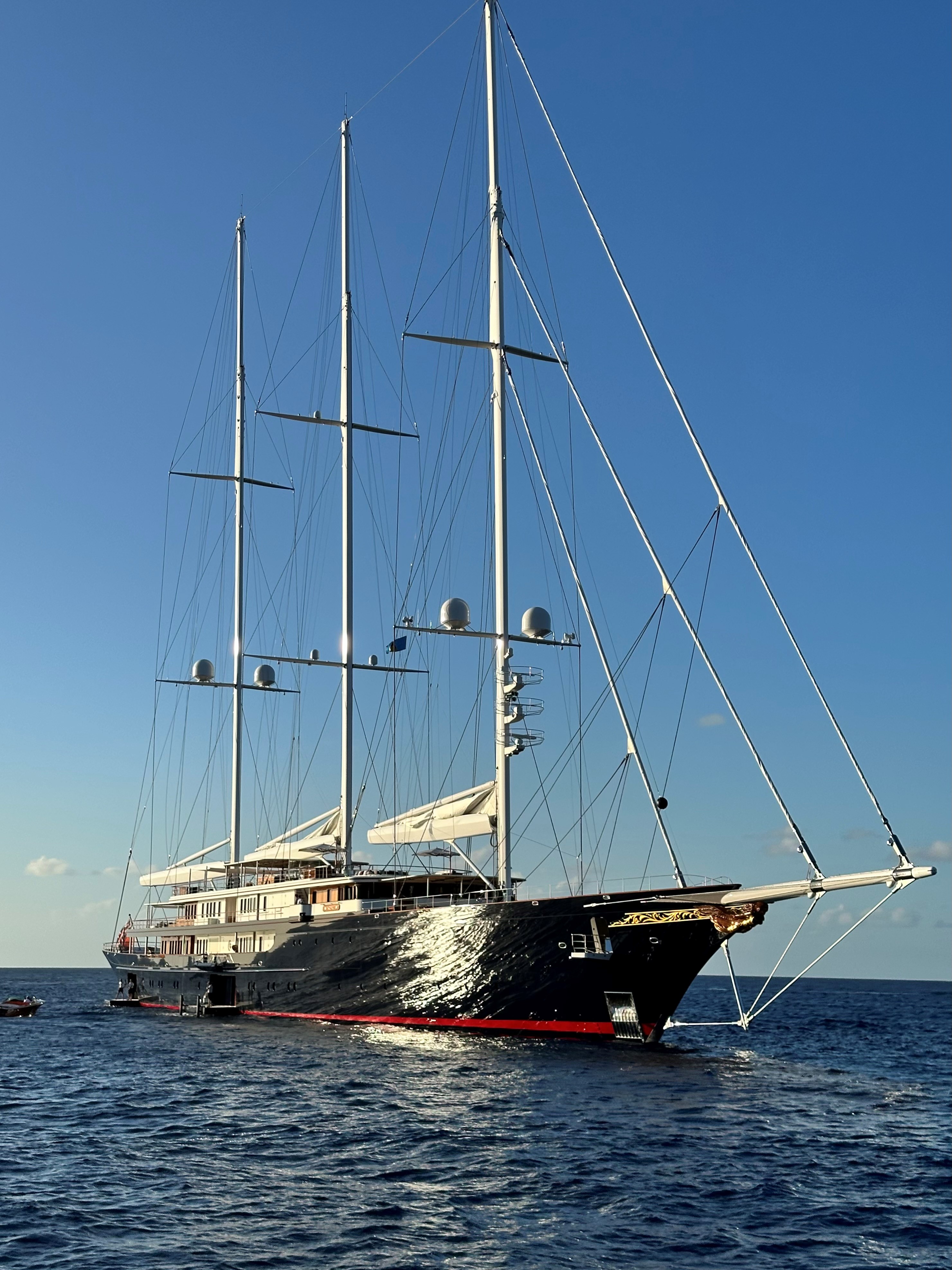
Conmat13 / Wikimedia Commons. Unmodified photograph, 15 January 2024.
The question is not “will it disappear?”
At sea, the most persistent disposal myth is that distance makes almost anything acceptable. It does not. The governing logic of MARPOL Annex V is the reverse: discharge of garbage is prohibited unless a narrow exception expressly permits it. That framework applies to ships of every type operating in the marine environment, including private pleasure craft and yachts. The useful question for an owner, captain or charter guest is therefore not whether an item is biodegradable, small or unlikely to be seen. It is: which MARPOL category does it belong to, is the yacht inside a special area, what distance and operating conditions apply, and do flag-state or coastal rules impose something stricter? This guide sets out that decision process using International Maritime Organization material reviewed on 17 October 2026. It is operational guidance, not a substitute for the yacht’s Garbage Management Plan, flag instructions, charted restrictions or local law.
The short answer: almost everything stays aboard
For an ordinary yacht passage, the conservative rule is simple: retain waste for a port reception facility. Plastics, synthetic rope, garbage bags, cooking oil, paper, rags, glass, metal, bottles, crockery and similar refuse may not be discharged at sea under the IMO’s current Annex V summary. “Biodegradable” packaging does not automatically become food waste, and a glass bottle does not become permissible because it sinks. The principal yacht-relevant exception concerns food waste, and even that exception changes by location and processing. Sewage is not governed by Annex V at all; it sits under MARPOL Annex IV. Grey water is another separate category. Mixing waste categories never creates a more permissive result: IMO guidance says that when garbage is mixed with material subject to stricter discharge requirements, the stricter rule applies.
Readable comparison | the global MARPOL baseline
PLASTICS, GLASS, METAL, PAPER, COOKING OIL AND SIMILAR DOMESTIC REFUSE — Discharge prohibited. Practical action: segregate, contain and land to a reception facility. GROUND OR COMMINUTED FOOD WASTE OUTSIDE A SPECIAL AREA — May be discharged only when the yacht is en route, as far as practicable from land and more than 3 nautical miles from the nearest land. The waste must pass through a screen with openings no larger than 25 millimetres. UNGROUND FOOD WASTE OUTSIDE A SPECIAL AREA — May be discharged only when en route, as far as practicable from land and more than 12 nautical miles from the nearest land. FOOD WASTE INSIDE AN ANNEX V SPECIAL AREA — Only comminuted or ground food waste is permitted, more than 12 nautical miles from the nearest land, while en route and as far as practicable. Unground food waste is prohibited. SEWAGE — Governed separately by Annex IV, with equipment, distance, speed and certification conditions. Do not apply the food-waste table to black water. This is a simplified operating aid. The Convention text, applicable amendments, flag rules and coastal-state requirements prevail.
Why the Mediterranean changes the galley routine
The Mediterranean Sea is an Annex V special area, alongside the Baltic, Black Sea, Red Sea, Gulfs area, North Sea, Wider Caribbean and Antarctic areas. The designation reflects ecological and oceanographic sensitivity and the character of traffic. For a Mediterranean yacht, the familiar outside-special-area allowance of three nautical miles for properly ground food waste does not apply. Under the IMO summary, food waste in a special area must be comminuted or ground, the yacht must be en route, the discharge must occur more than 12 nautical miles from the nearest land and as far from land as practicable. Unground food waste remains prohibited. In a coast shaped by islands, headlands and overlapping jurisdictions, “12 miles from the marina” is not the test; the rule is distance from the nearest land. The bridge team must establish position and legal context rather than rely on a casual estimate from the itinerary.
Black water: a different Annex and different thresholds
MARPOL Annex IV addresses sewage. Its revised international regime applies to ships on international voyages of 400 gross tonnage and above, or ships certified to carry more than 15 persons. Those ships must have an approved sewage treatment plant, an approved comminuting and disinfecting system, or a sewage holding tank. IMO’s baseline allows comminuted and disinfected sewage through an approved system more than 3 nautical miles from the nearest land. Untreated sewage may be discharged only more than 12 nautical miles from the nearest land, with the ship en route at not less than 4 knots and at an administration-approved discharge rate. An approved sewage treatment plant creates a different compliance route. These thresholds do not mean a smaller yacht has a free pass. Domestic implementation, flag-state rules, harbour regulations, protected areas and local no-discharge provisions can be stricter or apply to smaller craft. The correct onboard answer comes from the vessel’s approved system, certificates, operating manuals and current voyage-specific legal check—not from a generic distance remembered from another boat.
Grey water, deck wash and the hidden chemical question
IMO’s Annex V implementation guidelines define grey water as drainage from showers, baths, washbasins, laundry and dishwashing, excluding sewage sources and cargo-space drainage. The same guidelines state that grey water is not garbage for Annex V purposes. That classification is often misunderstood as a universal permission to discharge it. It is not: coastal states, ports, anchorages and environmentally protected zones can regulate grey water separately, and the yacht’s own environmental procedures may be stricter. Deck and exterior wash water introduces another distinction. Cleaning agents and additives may be discharged under Annex V only when they are not harmful to the marine environment. IMO guidance says the yacht’s records should contain evidence from the producer—such as a dated supplier statement or appropriate Safety Data Sheet—that the product meets the relevant criteria. A bottle labelled “marine” or “eco” is marketing, not by itself compliance evidence.
The paperwork thresholds many yachts cross
Annex V is not only about what goes overboard. Every ship 12 metres or more in length must display placards that notify passengers and crew of the disposal requirements. Ships of 100 gross tonnage and above, and ships certified to carry 15 persons or more, must carry a Garbage Management Plan with written procedures for minimising, collecting, storing, processing and disposing of garbage, and a named responsible person. The current IMO overview also requires a Garbage Record Book for ships of 100 gross tonnage and above, and for ships certified to carry 15 persons or more when engaged in voyages to ports or offshore terminals under another MARPOL party’s jurisdiction. Disposal and incineration entries include date, time, position, description and estimated amount, with signature requirements; the book is retained for two years after the last entry. These are material thresholds for the superyacht fleet. A beautifully finished galley and beach club still depend on disciplined segregation, labelled storage, crew training and auditable records below decks.
A practical pre-departure waste plan
1. IDENTIFY THE LEGAL LAYERS — Confirm flag-state implementation, coastal-state rules, port and protected-area restrictions, and whether the route enters an Annex V special area. 2. PLAN RECEPTION FACILITIES — Check availability before departure and before busy turnaround ports. IMO’s public GISIS system includes member-state information on port reception facilities, but the agent or port should still confirm current capability, opening times, segregation and paperwork. 3. REDUCE AT SOURCE — Ask suppliers for reusable crates, returnable containers and less single-use packaging. The easiest waste to store safely is the waste that never comes aboard. 4. SEGREGATE CLEARLY — Keep plastics, glass, metals, cooking oil, hazardous items, food waste and recyclables in controlled streams. Train temporary and charter crew to the yacht’s exact system. 5. CONTROL FOOD-WASTE EQUIPMENT — If relying on a comminuter, verify that it is operational and that the output meets the 25-millimetre screen standard. A broken macerator removes the exception; it does not relax the rule. 6. LOG AND LAND — Record the operations the vessel is required to record, retain receipts where useful, and use authorised reception facilities.
What an owner or charter client should ask
A serious environmental standard can be tested with precise questions. Where is the current Garbage Management Plan? Which person is responsible? How are galley waste, plastics, glass, oil and hazardous items separated? Which reception facility is booked at the next port? What evidence supports the cleaning products used on deck? When was the sewage treatment or holding system last serviced? Which local restrictions apply in the intended anchorages? The point is not to turn guests into inspectors. It is to distinguish a rehearsed sustainability claim from a functioning management system. Good yachts make compliance almost invisible to the guest because storage, training, procurement and engineering have already been organised. The visible luxury remains effortless; the substance below is a crew that can explain where every waste stream goes.
Source transparency and limits
This article uses the IMO’s Annex V overview, its simplified discharge table, the 2017 implementation guidelines, the IMO Annex IV sewage overview and the GISIS reception-facility information page. The discharge table itself carries a warning that additional requirements may apply and that the Convention provisions prevail. TNC has not inspected a vessel, audited a Garbage Record Book or tested a treatment plant for this article. No claim is made about a particular yacht’s compliance. Rules and local enforcement can change after the review date of 17 October 2026. Captains and operators should verify current official notices, flag-state instructions and coastal requirements for the actual voyage.
Sources & further reading
IMO — Prevention of Pollution by Garbage from Ships (MARPOL Annex V) ↗
IMO — Simplified overview of revised MARPOL Annex V discharge provisions ↗
IMO — 2017 Guidelines for implementation of MARPOL Annex V (MEPC.295(71)) ↗
IMO — Prevention of Pollution by Sewage from Ships (MARPOL Annex IV) ↗
IMO — Port Reception Facilities Database information ↗
Wikimedia Commons — Koru Superyacht photograph and CC BY-SA 4.0 licence ↗