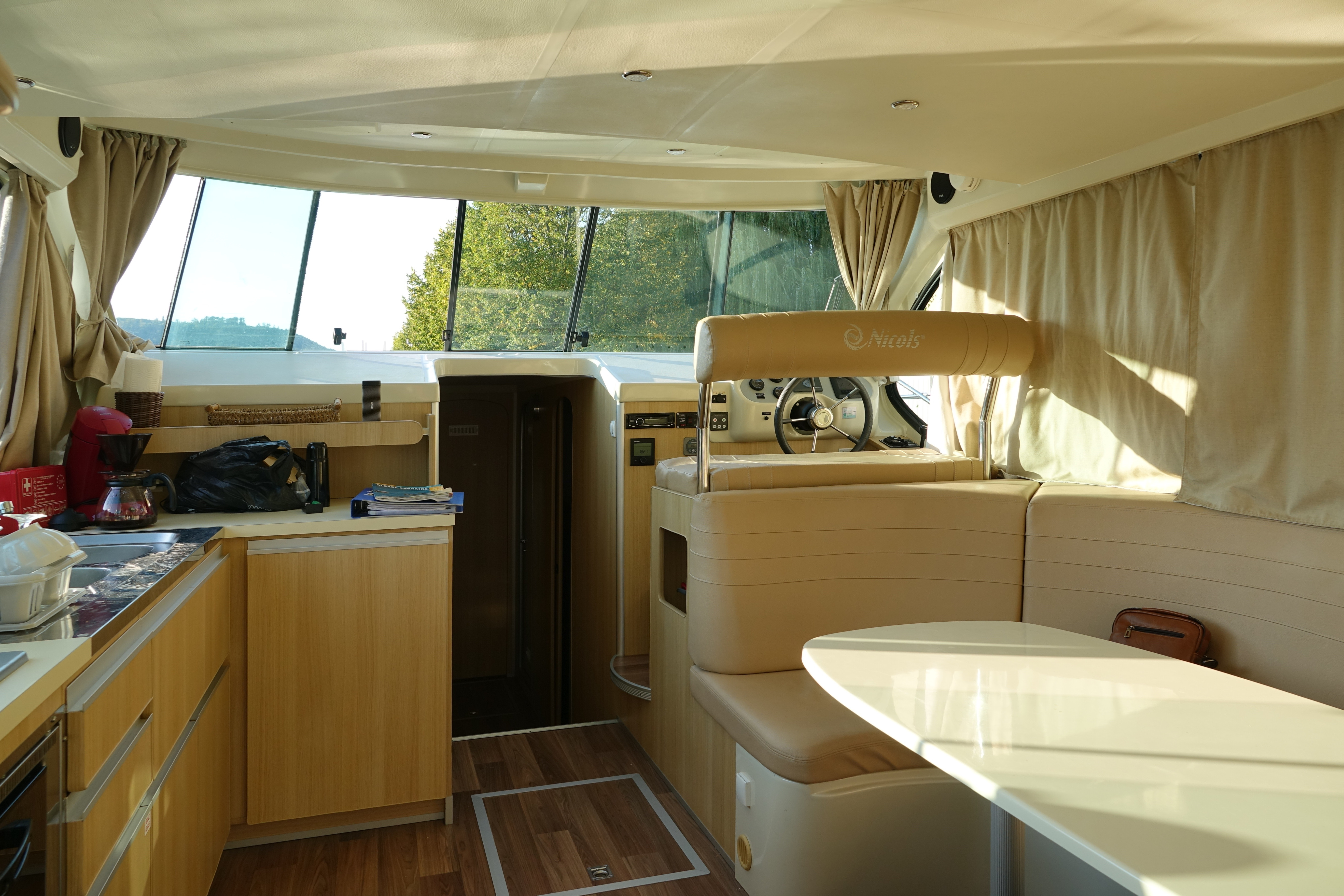
Gzen92 / Wikimedia Commons
The question this guide answers
What changes when a yacht carries an electric tender, e-foil, diver propulsion unit or other lithium-ion equipment? The answer is not simply ‘use the right charger’. Once substantial battery energy enters a yacht’s garage, the design problem expands to storage, ventilation, early detection, electrical isolation, emergency response and the possibility of re-ignition. This guide separates current regulatory guidance from practical inference and manufacturer-specific instructions. It is current to 21 October 2026 and does not replace the yacht’s flag, class, safety-management system or equipment manuals.
Why the battery belongs in the yacht’s fire strategy
Lithium-ion cells store a great deal of energy in a compact package. The principal escalation mechanism is thermal runaway: self-heating accelerates faster than the cell can reject heat, potentially spreading from one cell to the next. The UK Maritime and Coastguard Agency’s MGN 681 Amendment 1 warns that a lithium-ion fire can continue without an external oxygen supply, retain substantial heat after apparent extinguishment and re-ignite. It also identifies flammable and hazardous off-gases. EMSA’s ship-battery guidance frames the same design challenge around fire and explosion risk from thermal runaway and off-gas generation. The practical implication is important: removing flame does not necessarily mean the event is over. Cooling, atmosphere control, boundary protection and continued monitoring remain part of the response.
Two different installations are often confused
A permanently installed Battery Energy Storage System, or BESS, may support propulsion, hotel loads, peak shaving or emergency services. EMSA’s non-mandatory guidance addresses such installations at 5 kWh and above and treats the battery modules, connections, cooling, Battery Management System and safety functions as one integrated system. An electric tender or water toy carried aboard is a different use case: a powered craft is stowed, launched and exposed to salt water, while removable spare batteries may be handled and charged separately. MGN 681 is specifically written around small electric craft on yachts. The documents overlap in safety logic but are not interchangeable rulebooks.
The energy scale is larger than the word ‘toy’ suggests
MCA guidance gives indicative—not universal—capacity bands: 40–100 kWh for electric tenders, 20–50 kWh for electric personal watercraft, 1–3 kWh for diver propulsion units and 1–5 kWh for e-foils or powered stand-up paddleboards. These are regulator examples, not specifications for every product. Owners should use the data plate and manufacturer documentation for the actual equipment. MGN 681 applies its detailed storage approach to batteries above 100 Wh, while also warning that an accumulation of smaller batteries exceeding 500 Wh deserves crew attention. Capacity alone does not determine consequence, but it is a useful first screen for deciding whether the yacht’s casual charging habits have become an engineered fire-safety issue.
What a credible installation must prove
For a permanently installed ship battery system, EMSA’s high-level objective is safety, availability, reliability and maintainability comparable with a new conventional power arrangement. It calls for control, alarm, monitoring, disconnection and emergency shutdown, and says a single technical failure should not defeat the intended safety level. Its risk-assessment scope includes electrical and fire safety, structure, ventilation, venting, reliability, power availability, physical arrangement, operation, maintenance and human error. This is guidance rather than a universal yacht approval certificate. The binding hierarchy remains the applicable statutory requirements, flag instructions and class rules; MGN 681 itself says those take precedence over its supplemental recommendations.
Storage is not simply a free shelf in the garage
MGN 681 recommends that electric craft be kept in a space meeting the fire protection, firefighting, ventilation and monitoring standard of the Red Ensign Group Yacht Code garage provisions, or an equivalent container. It says removable batteries above 100 Wh should be in a dedicated compliant cabinet or locker within such a space, with a carefully defined open-deck alternative. That open-deck location should be separated from combustible material and kept away from escape routes, embarkation stations and lifesaving appliances. On a real yacht, the correct solution depends on flag, class, tonnage, layout and the equipment approval. A crew member should never infer that a metal box alone constitutes a compliant battery locker.
Charging is an operation, not background housekeeping
The safest charging plan begins with compatibility: the exact approved charger, undamaged connectors, the manufacturer’s temperature and humidity limits, secure cable routing and a location designed for the task. MGN 681 recommends charging in a dedicated compliant battery space or externally under controlled conditions. It also calls for mechanical restraint so motion cannot pull a cable free or damage the battery, and for clear identification of the compatible equipment and maximum battery size. Damaged batteries must not be charged. Reducing the number of battery and charger types aboard lowers the chance of a wrong-device connection. A yacht’s procedure should also define who authorises charging, whether it is continuously attended or remotely monitored, and what alarms require immediate shutdown.
The Battery Management System is essential—but not magical
A BMS can monitor cell temperature, state of charge and state of health; it may limit charging, isolate a cell or disconnect a pack when it detects a serious fault. MGN 681 recommends interfacing available BMS alarms with the yacht’s alarm or safety centre, including audible and visual warning and charge shutdown. EMSA treats the BMS, thermal management and fire or explosion controls as essential BESS safety functions whose power continuity must be considered. The limitation is equally important: a BMS is an engineered layer, not proof that charging anywhere is safe. Sensor, software, wiring, cooling and communication failures must be addressed by the wider design and operating procedure.
Ventilation must deal with an uncertain gas cloud
The MCA notes that battery off-gases may accumulate low or high because the mixture and conditions vary. Its guidance therefore calls for mechanical extraction from both the upper and lower parts of a battery compartment, independent from unrelated spaces, with capacity related to the potential release. This is not an invitation to improvise a fan: ignition protection, duct fire integrity, dampers, discharge location and emergency control all require professional design. EMSA similarly includes ventilation and venting in the formal risk assessment. The crew’s immediate concern is that vapour or an unusual odour can be an early danger signal, not just an unpleasant smell.
Detection should see the event before flame
MGN 681 recommends combined smoke, heat and gas monitoring for battery compartments, local and continuously manned alarms, and camera surveillance; thermal imaging is identified as a potentially useful additional tool. The document is cautious about specialised off-gas detectors because marine airflow and exhaust contamination can influence readings. A robust plan therefore does not rely on one novel sensor. It combines the BMS, fixed fire detection, temperature trends, visual surveillance and human rounds, with clear escalation criteria. The yacht should test alarms and remote indications as a complete chain, not as isolated components.
A practical warning-sign matrix
NORMAL — stable temperature, no deformation or leakage, correct charger and no alarm: continue only within the approved operating procedure. ABNORMAL — unexpected temperature rise, fault alarm, damaged casing, connector damage or coolant/fluid leakage: stop charging if this can be done safely, isolate according to the vessel procedure, establish an exclusion zone and call the responsible officer. EMERGENCY — hissing, popping, a sweet chemical smell, black particulate emission, white vapour, rapid heating or flame: treat as a possible thermal-runaway event, raise the alarm and execute the yacht-specific emergency plan. These signs are taken from MCA guidance; the response sequence must come from the vessel’s accepted risk assessment and equipment instructions, not from an online article.
Salt water changes the assessment
Electric tenders and toys are repeatedly launched, recovered, washed and exposed to impact. MGN 681 says damage and saline penetration materially increase fire risk. A post-use inspection should therefore be more than cosmetic: look for impact, swelling, cracked seals, corrosion, fluid, connector damage, water ingress indication and abnormal BMS messages. Record the incident even if the unit appears to recover. A battery that has been submerged, struck or otherwise compromised should be quarantined and evaluated under the manufacturer’s procedure; it should not quietly return to charge because the casing has dried.
What to ask before purchasing the next electric tender
Ask the builder and yacht’s technical advisers for five evidence packages. First, certified battery and charger documentation, including applicable conformity and marine-use standards. Second, the real energy capacity, chemistry, operating limits and transport classification. Third, the yacht-side arrangement drawing for stowage, charging, ventilation, detection, isolation and fire response. Fourth, the BMS alarm list and its interface with the vessel. Fifth, a written plan for damaged batteries, shore removal, service support and crew training. Marketing range, silence and acceleration are not safety evidence. If the garage cannot support the installation, the answer may be a different product, a deck solution designed and approved for the purpose, or no carriage at all.
Claim, guidance and uncertainty—kept separate
Regulator guidance: the capacity examples, warning signs, storage approach, charging controls and detection recommendations above come from MCA MGN 681 Amendment 1, issued 13 January 2026. Agency guidance: the system-level BESS principles come from EMSA’s non-mandatory guidance, published in 2023 and shown by EMSA as updated in November 2025. Current international position: IMO reported in May 2026 that work on a dedicated safety framework for lithium-ion batteries and shipboard BESS would continue; this means readers should not mistake the absence of one global battery code for the absence of flag, class or statutory duties. Manufacturer-specific facts: chemistry, energy, temperature limits and emergency actions must be verified for each product. Not publicly verified here: the performance of any particular yacht installation, battery brand or suppression system.
The owner’s one-page readiness check
Before the first charge aboard, confirm: the flag and class basis; an installation-specific risk assessment; approved battery and charger documentation; a dedicated compliant stowage and charging location; ventilation and safe discharge; BMS integration; fixed detection and alarm transmission; electrical isolation and emergency shutdown; restraint for sea motion; inspection after salt-water use; a written damaged-battery pathway; trained crew; drills that include re-ignition monitoring; and shore contacts able to remove or service the equipment. If one of these is missing, the right response is not confidence by analogy with a phone or laptop. It is to stop, document the gap and obtain competent marine advice.
Sources & further reading
MCA — MGN 681 (M) Amendment 1: Fire safety and storage of small electric powered craft on yachts ↗
EMSA — Guidance on the Safety of Battery Energy Storage Systems (BESS) ↗
EMSA — Guidance on the Safety of BESS on board ships (PDF) ↗
IMO — Maritime Safety Committee 111th session summary, May 2026 ↗